Home page of Katsuya Eda
Hawaiian Earring
-
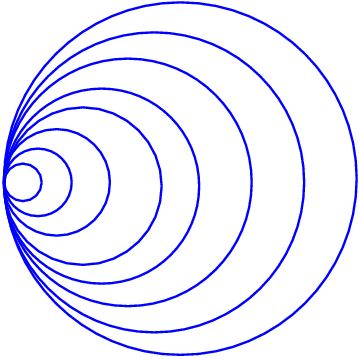
The Hawaiian earring is the plane compactum consisting of infinitely
many circles
(jpg-file).
In 1950's there were a few researches about the
fundamental group of the Hawaiian earring by H.B. Griffiths and
G. Higman. In 1998 K. Kawamura and I succeeded to get an
explicit presentation of the singular homology group of the Hawaiian
earring, i.e. the abelianization of the fundamental group. It turns out
to be the direct sum of the following groups:
(1) The direct product of countably many copies of the
integer group;
(2) The direct sum of the continuum many copies of the
rational group;
(3) The Z-adic completion of the free abelian group of
the continuum rank.
(These results are in the paper `The singular homology of the
Hawaiian earring' in the list.)
-
A well-known result due to M. Barratt and J. Milnor is
that the 3-dimensional singular homology group of the 2-dimensional
Hawaiian earring is non-trivial.
We proved that the n-dimensional homotopy group of
the n-dimensional Hawaiian earring is isomorphic to
the direct product of countably many copies of the
integer group and the k-dimensional homotopy group of
the n-dimensional Hawaiian earring is trivial in case
n is strictly greater than 1 and k is strictly less than n. Consequently,
the n-dimensional singular homology group of
the n-dimensional Hawaiian earring is isomorphic to
the direct product of countably many copies of the
integer group.
-
In 1998 I proved: If the fundamental groups of everywhere
non-semi-locally simply connected one dimensional Peano continua (*) are
isomorpohic, then they are homeomorphic. The proof uses the fundamental
group of the Hawaiian earring. Based on this theorem, in 1999 Greg
Conner and I introduced a new construction of a space from an abstract
group using the fundamental group of the Hawaiian earring. This detects
a wildness of a space from its fundamental group and for a space (*) the
construction from its fundamental group produces the space itself.
Consequently, one dimensional fractals with non-trivial fundamental
groups and also finite
or countable direct products of such fractals can be recovered from
their fundamental groups. This new construction of a space also makes
possible to treat with certain properties of spaces in group-theoretic
terms.
- In December of 2008 I proved that the fundamental groups of one
dimensional Peano continua determine their homotopy types. (pdf-file
is available. Also another pdf-file
is available.)
But, there
are still unknown things even about the fundamental group of the
Hawaiian earring.
- In June of 2012, contradicting to my conjecture, I've proved
that the first singular homology groups of one dimensional Peano
continua are isomorphic
to free abelian groups of finite rank or the first singular homology
group of the Hawaiian earring. (pdf-file is available.)
Specker Phenomenon
- The name "Specker phenomenon" was given by A. Blass in 1994, but the
phenomenon itself was discovered by E. Specker in 1950. Specker
proved that each homomorphism from the countable direct product of
copies of the integer group to the integer group factors through a
finite generated free abelian group which is a canonical
summand. This appears a surprising fact, when we replace the range
of a homomorphism to the rational group. In that case there exist 2
to the continuum many homomorphisms, while there exist only
countably many and natural homomorphisms when the range is the
integer group. In 1952 G. Higman proved the non-commutative
variant of Specker's theorem. In topological terms Higman's theorem says:
Any homomorphism from the fundamental group of the Hawaiian earring
to that of a Bouquet is induced from a continuous map from the
Hawaiian earring to the Bouquet. Using infinitary word theoretic
argument as well as the Higman theorem, I proved that every
endomorphism on the fundamental group of the Hawaiian earring is
conjugate to an endomorphism induced by a continuous map (in a
published paper in the list). This is a prototype of above
statements which are some-what unexpected concerning fundamental
groups of wild one dimensional Peano continua. This non-commutative
variation of the Specker phenomenon is a key concept for the
investigation of fundamental groups of wild spaces.
- Specker's theorem was investigated and generalized in abelian
group theory and there are some applications of slender abelian groups
to Topology. But there was no application of its non-commutative
variation, i.e. Higman's theorem. The main reason seems to be owing to
the following. The one is an obvious fact that uncountable
non-commutative groups are out of interests of many mathematicians.
Another may be that the presentation of the fundamental group due to H.
B. Griffiths was done after the publication of the Higman paper, but
there was no serious mentioning to the Higman paper in the Griffiths
paper. It's likely that H. B. Griffiths did not notice it.
- Now the most interesting problem in this area is to
characterize the
n-slenderness, i.e. the non-commutative version of the slenderness
in abelian group theory. For a long time I've thought that finitely
generated torsionfree groups should be n-slender, but Greg Conner
informed me that the rational is a subgroup of a finitely presented
group, which can be proved using Higman's old result. Hence, the
n-slenderness is in question even for finitely presented groups? The
n-slenderness is closed under free products, but I don't
know whether the n-slenderness is closed under the amalgamated free
product.
Pdf-file of talk
at Dubrovnik
2015
Pdf-file of talk
at Kobe
2014
Pdf-file of talk
at Poznan
2014
Pdf-file of talk
at Gdansk
2014
Pdf-file of first talk
at Ljubljana
2013
Pdf-file of second talk
at Ljubljana
2013
Pdf-file of third talk
at Ljubljana
2013
Pdf-file of a talk in Strobl Workshop
2011
Pdf-file of a talk in Dubrovnik
conference
2011
Pdf-file of a talk in Kyoto Conference
2008
List of my papers related to the Hawaiian Earring
List of my papers not related to the
Hawaiian Earring
Go to the home
page.
2015 July 18
(c) 2015 Katsuya Eda